Why Was the Nile River Important? The Lifeline of Ancient Egypt Explained
The Nile River is often called the lifeblood of ancient Egypt, and for good reason. Without its annual floods, reliable waters, and fertile banks, one of the world’s earliest and most influential civilizations might never have risen from the surrounding desert. The river shaped nearly every part of Egyptian life, from what people ate and how they built to what they believed about the gods and the afterlife.
Why was the Nile River important? The answer stretches across thousands of years and thousands of miles. It provided water in a parched land, deposited rich soil after each flood, served as a superhighway for trade and communication, and became a sacred force in religion and royal power. Its influence did not end with the pharaohs; the Nile still supports millions of people and remains a source of political tension and cooperation in northeastern Africa.
The Nile as the Lifeline of Ancient Egypt
Ancient Egypt was a narrow strip of fertile land surrounded by vast deserts. The Sahara to the west and the Eastern Desert to the east made survival difficult without a dependable water source. The Nile cut through that harsh landscape like a green ribbon, creating an oasis hundreds of miles long where people could farm, build cities, and develop a complex society.


The river’s predictable flooding was especially important. Unlike the violent and unpredictable floods of Mesopotamia’s Tigris and Euphrates, the Nile rose and fell on a fairly regular schedule. That rhythm gave Egyptians confidence to plan their crops, store surplus grain, and organize labor for massive building projects. The river also acted as a natural boundary and transportation corridor, helping unify Upper and Lower Egypt into a single civilization.
The Annual Inundation and Agriculture
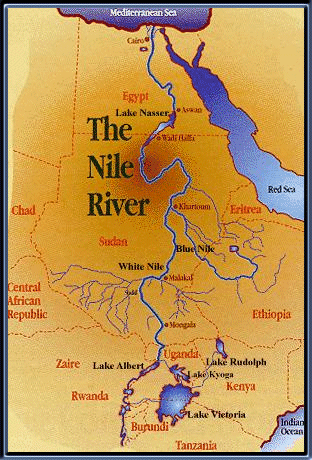
Each summer, monsoon rains in the Ethiopian Highlands swelled the Blue Nile, while the White Nile brought steady water from the Great Lakes region. When the combined waters reached Egypt, the river overflowed its banks and spread across the floodplain. As the water receded, it left behind a layer of dark, mineral-rich silt that renewed the soil year after year. Egyptians called their land Kemet, meaning the black land, because of this fertile deposit.


Farmers planted emmer wheat, barley, flax, and papyrus in the enriched soil. They used basin irrigation to trap floodwater and later channel it to fields through canals and dikes. The resulting agricultural surplus fed a growing population, supported priests, scribes, artisans, and soldiers, and made it possible to store grain for lean years. Agriculture along the Nile became the economic foundation of ancient Egypt and the reason its cities could thrive.
Transportation, Trade, and Communication
The Nile was ancient Egypt’s main highway. Roads were rare and expensive to maintain, but the river offered a cheap and efficient way to move people, goods, and troops. The current flowed north toward the Mediterranean, while prevailing winds blew south, allowing boats to sail upstream and drift downstream. This natural transportation system linked villages, towns, and temples from Nubia to the delta.
Trade flourished because of the river. Egyptians exchanged grain, linen, papyrus, and crafted goods for gold, ivory, ebony, incense, and timber from Nubia, Punt, and the Levant. Boats carried stone from quarries to pyramid and temple sites, and messengers traveled by water to deliver royal decrees. The Nile helped create a shared culture across Egypt and made the pharaoh’s administration more effective.


The Nile’s Role in Religion, Power, and Modern Survival
The Nile was not just a practical resource; it was sacred. Egyptians saw the river as a gift from the gods and a symbol of renewal, fertility, and order. Hapi, the god of the inundation, was honored with hymns and offerings. Osiris, Isis, and other deities were linked to the river’s life-giving power and the annual cycle of death and rebirth.
Control of the Nile also meant political power. The pharaoh who managed irrigation, stored grain, and protected the borders could claim divine legitimacy. The river supported the bureaucracy that collected taxes, organized labor, and maintained the calendar. Because the Nile was so central, its health was tied directly to the stability of the state and the authority of the ruler.
Sacred Geography and Cultural Identity
Egyptian temples, tombs, and cities were often built with the Nile as their reference point. The east bank was associated with life and the rising sun, while the west bank was associated with death and the setting sun. Many tombs and mortuary temples were placed on the west bank, and funerary rituals often involved crossing the river or traveling along it.

The Nile also shaped Egyptian identity and cultural achievements. Its cycles influenced the calendar, which divided the year into seasons of inundation, planting, and harvest. Priests and scribes studied the stars to predict the flood, and papyrus, made from a river plant, became one of the world’s first writing materials. Literature, science, and religion all bore the mark of the river’s presence.
Modern Importance and Transboundary Challenges
Today, the Nile remains essential to millions of people. The Aswan High Dam, completed in 1970, created Lake Nasser and gave Egypt greater control over flooding and irrigation. It generates hydroelectric power, supports year-round farming, and helps regulate the river’s flow. Cities and farms along the Nile still depend on its water for drinking, sanitation, industry, and agriculture.
The river is shared by eleven countries, including Egypt, Sudan, Ethiopia, Uganda, and Kenya. That shared dependence has created complex disputes over water rights, dams, and development. The Grand Ethiopian Renaissance Dam has become a major point of tension, while the Nile Basin Initiative seeks dialogue and cooperation. How these nations manage the river will affect food security, energy production, and peace for generations.
The Nile remains far more than a river on a map. It is a working inheritance that connects ancient temples to modern farms, and royal decrees to today’s water negotiations. Understanding its past helps us see how deeply human survival, culture, and power can be tied to a single flowing source. The next time you read about Egypt, Ethiopia, or the wider Nile Basin, remember that the river’s story is still being written.
Related Articles

Mayan Calendar Symbols: Meanings, Glyphs, and Ancient Secrets Explained
Mayan calendar symbols are far more than ornate decorations carved into ancient stone. They form a sophisticated glyphic language that the Maya used to record...

Celtic Ogham Year Wheel: Ancient Tree Calendar Explained
The Celtic Ogham year wheel is one of those concepts that feels ancient at first glance: a circular map of trees, letters, lunar months, and seasonal...

Libyan Sibyl: Prophecies, Mythology, and the Ancient Oracle Explained
The Libyan Sibyl stands among the most fascinating yet elusive prophetic figures of the ancient Mediterranean. She was a woman believed to speak for Zeus Ammon...

Nile River Drawing: Easy Step-by-Step Ideas for Stunning Scenes
The Nile River has inspired artists, cartographers, and travelers for thousands of years. A Nile River drawing can be a realistic landscape, a stylized map, a...

Why Are Aquifers Important? 7 Reasons Theyre Earths Hidden Lifeline
Beneath the surface of every continent lies a hidden reservoir that most people never see, yet it sustains a staggering portion of the world's population...

Nile River Africa: The Ultimate Guide to History, Wildlife, and Cruises
Your quota is exhausted. API key status: exceeded Name: PCTB8QC8QS7ST Quota: 0/3200000000 tokens (0.0%) exp_date: 2026-10-17T14:27:58.134Z