Sturgeon Maine: A Complete Guide to Fishing, Habitat, and Conservation
Sturgeon in Maine are older than the state, older than the continent's current shape, and arguably older than anything else swimming in its rivers. These fish belong to the family Acipenseridae, a lineage that stretches back more than 100 million years, and they have survived ice ages, shifting coastlines, and centuries of human industry. What makes them remarkable is not just their age but their biology: a cartilaginous skeleton instead of true bone, five rows of bony plates called scutes instead of scales, a toothless ventral mouth built for hoovering food off the riverbed, and lifespans that can outlast the people who study them.
Maine is one of the few places in the eastern United States where three sturgeon species still share the same geography. The Atlantic sturgeon, the shortnose sturgeon, and the lake sturgeon each occupy different niches in the state's rivers and estuaries, from the tidal reach of the Kennebec to the cold, free-flowing currents of the St. John in Aroostook County. Understanding which species lives where, how they are protected, and how to handle an accidental encounter is useful for anglers, paddlers, biologists, and anyone who simply wants to know what just leapt out of the water near the boat launch.
Three Ancient Species in Maine Waters
Sturgeon are built for patience rather than speed. They grow slowly, mature late, and reproduce infrequently, which is precisely why they are so vulnerable to overfishing, habitat loss, and pollution. A female Atlantic sturgeon may not spawn until she is well into her teens, and then only every few years. Lake sturgeon can live for a century or more, meaning a single individual may witness generations of dam construction, removal, and restoration. That slow life history is the thread connecting all three Maine species.


Maine's rivers provide a rare combination of habitats: long free-flowing stretches, tidal estuaries with deep channels, and cold northern watersheds that were never heavily industrialized. The Penobscot, Kennebec, Androscoggin, Saco, and St. John systems all carry some sturgeon history, and Merrymeeting Bay, where the Kennebec and Androscoggin meet, functions as a critical mixing zone. All three species are protected in Maine to some degree, with the shortnose and Atlantic sturgeon also covered by the federal Endangered Species Act.
| Species | Typical Size | Protection Status | Maine Strongholds |
|---|---|---|---|
| Atlantic sturgeon | 5 to 8 feet, occasionally larger | Federally listed (Gulf of Maine population threatened) | Kennebec, Penobscot, Androscoggin, Saco estuaries |
| Shortnose sturgeon | 3 to 5 feet | Federally endangered | Kennebec River, Merrymeeting Bay |
| Lake sturgeon | 4 to 6 feet, sometimes larger | Maine species of special concern, no open season | St. John River drainage, Aroostook County |
Atlantic Sturgeon: Maine's Largest Fish
The Atlantic sturgeon is the heavyweight of the group and the largest fish most Mainers will ever see in fresh or tidal water. Adults commonly run five to eight feet, and historical records describe individuals approaching fourteen feet and several hundred pounds. They are anadromous, meaning they spend most of their lives in coastal marine waters and return to freshwater rivers to spawn, often homing back to the drainage where they were born. Their snout is long and slightly upturned, and their scutes form five distinct rows along a body that looks armored rather than scaled.


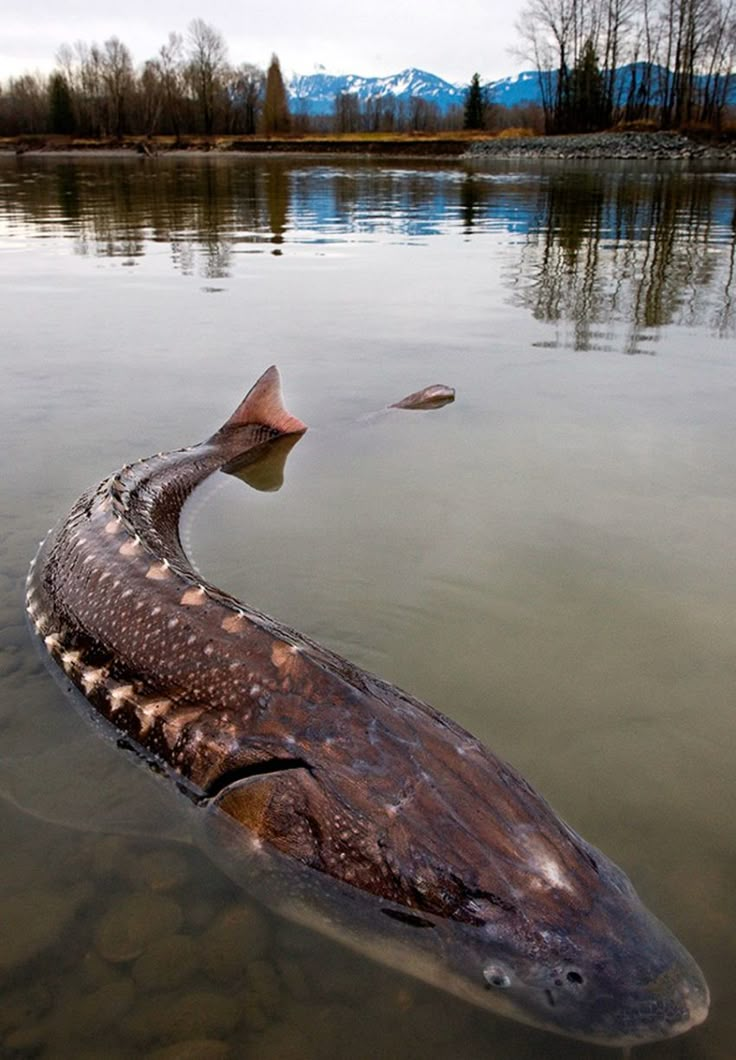
In Maine, Atlantic sturgeon use the Kennebec, Penobscot, Androscoggin, and Saco systems, with the tidal portions of these rivers acting as important travel corridors. The Gulf of Maine population was listed as threatened under the Endangered Species Act in 2012, following decades of bycatch mortality, ship strikes, and blocked spawning habitat. One of the most visible behaviors associated with the species is breaching, when a fish launches most of its body clear of the surface and crashes back down, a spectacle that has puzzled researchers for years and delighted anyone lucky enough to witness it.
Shortnose Sturgeon: The Kennebec's Quiet Comeback
The shortnose sturgeon is smaller, stockier, and blunter-snouted than its Atlantic cousin, rarely exceeding five feet and usually weighing under thirty pounds. It has been protected since the late 1960s and is listed as endangered throughout its range. Unlike Atlantic sturgeon, many shortnose populations are largely riverine, spending most or all of the year within a single river system rather than roaming the open ocean. They feed on mollusks, crustaceans, and aquatic insect larvae, using sensitive barbels under the snout to locate prey in soft sediment.
The Kennebec River population is one of the most closely watched shortnose sturgeon groups on the East Coast, and it is often described as a genuine success story in progress. The removal of Edwards Dam in Augusta in 1999 reopened more than seventeen miles of historic spawning habitat, and researchers have since documented sturgeon moving upstream into stretches that had been blocked for over a century. Challenges remain, including summer low-oxygen conditions, dredging projects, and the ongoing presence of downstream dams, but the trajectory of the population has shifted in a hopeful direction.


Lake Sturgeon and Northern Maine's Free-Flowing Rivers
Lake sturgeon are the freshwater members of the family, and they are the longest-lived of the three Maine species. Individuals over a century old have been documented elsewhere in their range, and some biologists believe the oldest fish could approach 150 years. They spawn in rivers but spend much of their adult lives in lakes and larger river pools, and they grow to impressive sizes, with large adults reaching five to six feet and well over a hundred pounds. In Maine, lake sturgeon are classified as a species of special concern, and there is no open season for them.
Their life history is almost deliberately unhelpful for population recovery. Males may not spawn until their teens, females until their twenties, and spawning happens only every few years at that. A single failed spawning season, a blocked riffle, or a stretch of poor water quality can set a cohort back by a decade. That is why the remaining intact habitats in northern Maine matter so much, and why biologists treat every confirmed lake sturgeon sighting as meaningful data rather than a casual curiosity.
The St. John River: Maine's Lake Sturgeon Heartland
The St. John River drainage in Aroostook County is the core of lake sturgeon habitat in Maine. Unlike many major New England rivers, the upper St. John retains long stretches of free-flowing water with clean gravel riffles and deep holding pools, the exact combination sturgeon need for spawning and overwintering. The watershed's relative lack of large main-stem dams is a significant advantage, since connectivity between feeding, spawning, and wintering areas is essential for a fish that migrates within its home river system.


Lake sturgeon in the St. John have been documented through a combination of angler reports, targeted surveys, and cooperative research with Canadian agencies, since the river continues north into New Brunswick and Quebec. Beyond the St. John drainage, reports of lake sturgeon elsewhere in Maine are rare and often unverified, which suggests the species' modern range within the state is narrow. Protecting that narrow range, including shoreline buffer zones and spawning substrate, is a practical conservation priority rather than an abstract one.
Recovery Research and Dam Removal
Maine has quietly become one of the more interesting places in the Northeast to study sturgeon recovery. The Penobscot River Restoration Project removed the Veazie and Great Works dams and decommissioned the Howland dam between 2012 and 2016, reopening hundreds of miles of habitat. On the Kennebec, Edwards Dam came out in 1999 and Fort Halifax Dam in Winslow was removed in 2008. Each of those projects changed the physics and chemistry of the river, and each created a natural experiment for tracking how a slow-growing fish responds to newly accessible water.
Researchers from the University of Maine, the Maine Department of Marine Resources, and federal agencies use acoustic telemetry tags, egg mats, larval sampling, and genetic sampling to piece together sturgeon movements and spawning activity. Evidence has been building that Atlantic sturgeon are using restored Penobscot habitat, and that shortnose sturgeon in the Kennebec continue to expand their upstream range. The work is slow by necessity, because the animals themselves are slow, but the data increasingly supports the argument that habitat reconnection is one of the most effective tools available.
Watching Sturgeon and Fishing Responsibly
Maine's sturgeon are not a recreational target species, and that is a deliberate policy choice rather than an oversight. Atlantic and shortnose sturgeon are protected under the federal Endangered Species Act, and lake sturgeon are protected by state rules that prohibit possession. There is no legal season, no bag limit, and no size slot. Any sturgeon caught incidentally while fishing for something else must be released immediately, with as little handling as possible, and unharmed.
That does not mean sturgeon are irrelevant to anglers. They are caught accidentally on everything from striped bass gear in tidal rivers to catfish rigs in northern pools, and how a fisher handles those few seconds can determine whether the fish survives. A sturgeon's armor and size make it look tougher than it is. Their skeletal structure is cartilage, their gills are delicate, and their slime layer protects against infection. Treating every encounter as a high-stakes release is the correct instinct.
Regulations Every Angler Should Know
If a sturgeon takes your bait, do not lift it by the gills, do not gaff it, and do not drag it onto a hot, dry dock. Keep the fish in the water, support its body horizontally if you need to remove a hook, use wet hands or a wet net, and cut the line if the hook is deep or the fish is large. Prolonged handling and air exposure are the biggest threats during a release. If you are in a boat, keep the fish alongside in the water rather than hauling it aboard.
Reporting matters as well. State and federal biologists want to know where sturgeon are encountered, because those reports help fill gaps in survey data, especially in rivers that receive less research attention. Photographing the fish quickly in the water, noting the location and date, and passing that information along to the Maine Department of Marine Resources or a regional biologist all contribute to the broader picture. It is one of the few cases where an accidental catch can actually be useful to science.
Where and When to Watch Sturgeon Breach
The breaching behavior that makes sturgeon so memorable tends to peak in the warmer months, roughly from late spring through early fall, when fish are moving through tidal rivers and estuaries. Merrymeeting Bay and the Kennebec between Bath and Augusta are classic viewing areas, and the tidal Penobscot below Bangor has produced its share of dramatic leaps as well. Breaching sturgeon look like small, dark submarines briefly turned into missiles, and they often land with a slap that carries across the water.
Viewing ethics are simple: watch from a respectful distance, do not chase a fish with a boat or a paddle, and leave drones on shore. Repeated pursuit forces sturgeon to burn energy they need for migration and spawning, and it can push them out of preferred habitat. Shorelines, bridges, and anchored boats are ideal vantage points. Bring binoculars, be patient, and treat a breach as a gift rather than a target, because the fish decides when the show happens.
Maine's sturgeon represent something increasingly rare in the eastern United States: a set of ancient, slow-moving species that still have room to recover. The combination of dam removals, protective regulations, and growing public awareness has created genuine momentum, even if the results will take decades to fully appear. If you spend time on a Maine river this year, whether with a rod, a paddle, or just a thermos of coffee on a dock, keep an eye on the water and learn the rules before you go. The next breach might be a hundred-year-old fish, and it is worth knowing what you are looking at.
Related Articles

Acadian Redfish: The Complete Guide to Taste, Habitat, and Sustainable Seafood
The Acadian redfish, also known as ocean perch, is a deep-water fish with a striking red color and a fascinating life history. Found in the cold waters of the...

Types of Musk Turtles: A Complete Guide to Species, Care, and Habitat
Musk turtles are among the most fascinating and accessible aquatic turtles for hobbyists and nature enthusiasts alike. Belonging to the genus Sternotherus...

Alabama Red Bellied Turtle: The Complete Care Guide, Habitat, Diet & Fun Facts
The Alabama red-bellied turtle, scientifically known as Pseudemys alabamensis , is one of the most fascinating and geographically restricted freshwater turtles...

Gopher Tortoise Habitat: Essential Facts, Range, and Conservation Guide
Your quota is exhausted. API key status: exceeded Name: PCTB8QC8QS7ST Quota: 0/3200000000 tokens (0.0%) exp_date: 2026-10-17T14:27:58.134Z

Oregon Dept of Fish and Wildlife: Your Guide to Hunting, Fishing, and Conservation
Oregon is a state defined by its rivers, its coastline, its high desert, and the wildlife that moves through all of it. Standing at the center of that...

Triple Tail Fish: The Ultimate Guide to Habitat, Taste, and Fishing Tips
Tripletail fish, often written as triple tail fish, are among the most unusual and captivating species found in warm coastal waters. With a deep body, mottled...