Medieval Italian Fashion: Elegance, Opulence & Historic Style
Step into the piazza of a fourteenth-century Tuscan town and the first thing you notice is not the architecture but the clothing. Medieval Italian fashion was never a single uniform look, because "Italy" itself was a patchwork of rival city-states, each with its own textile guilds, trade connections, and moral watchdogs. A wool merchant from Florence, a silk patrician from Venice, and a condottiere passing through Milan could all be dressed in garments that shared basic construction but differed wildly in fabric, cut, and ornament. What united them was a shared understanding that clothing was a public ledger of wealth, family standing, and political ambition.
Between the collapse of Roman administrative order and the flowering of the Renaissance, the peninsula absorbed Byzantine brocades, Islamic weaving techniques, and Northern European tailoring innovations, then transformed them into something distinctly local. The result was a two-century explosion of sartorial creativity that shaped the layered female gown, the fitted male doublet, and the entire concept of the professional tailor. Understanding medieval Italian fashion means reading the clothing of the period as a document — one written in silk thread, kermes dye, and gold buttons.
The Raw Materials of Status: Fabrics, Dyes, and Sumptuary Law
Before anyone could worry about silhouettes, they had to worry about cloth. The overwhelming majority of medieval Italians wore wool, linen, or a blend of the two, because these fibers were affordable, durable, and locally produced. Florence built a substantial part of its fortune on the Arte della Lana, the wool guild, which imported raw fleece from England, Spain, and North Africa, then finished it in the Arno valley and exported the results across Europe. Quality was strictly graded, and the difference between a coarse working tunic and a fine, closely woven cloth was visible from across a street.


Above this practical foundation sat an imported luxury economy that drove fashion forward. Silk had been woven in southern Italy and Sicily since the Norman period, and by the thirteenth century Lucca had become one of Europe's great silk cities. Velvet, damask, brocade, and cloth of gold arrived through Genoese and Venetian galleys, along with cotton from the Levant and furs from the north. Wearing these materials was not simply a matter of taste; it was an economic act that funded the very trade networks that kept the peninsula prosperous.
Silks, Velvets, and the Trade Routes That Shaped Dress
Lucchese weavers developed techniques for producing silk velvet with a deep, light-catching pile, and their patterned silks were prized from Avignon to Bruges. When political turmoil disrupted Lucca in the early fourteenth century, many of its skilled weavers migrated to Florence, Venice, Bologna, and Genoa, taking their looms and technical secrets with them. Venice in particular parlayed its maritime empire into a near-monopoly on the finest figured silks, and by the quattrocento the Venetian Senate was actively regulating thread counts and gold content to protect the city's reputation.


The cost of such fabric made it an object of inheritance in its own right. Surviving wills and inventories from Tuscany show gowns bequeathed alongside land and jewelry, sometimes with instructions that the fabric be reused or recut for another family member. Garments were regularly unpicked, the panels turned, and the material reassembled into a new style, which is one reason relatively few complete medieval Italian dresses survive today. A single length of figured silk might pass through three owners before it finally wore out.
Color, Dyes, and the Sumptuary Legislation
Color carried meaning, and achieving it required chemistry as much as cash. The most coveted red came from kermes, a dye extracted from insects collected in Iberia and southern Italy, and it produced a rich scarlet that only the wealthy could afford. Blues came from woad, yellows from saffron grown in Abruzzo and Tuscany, and deeper purples from a range of expensive Mediterranean sources. Alum, the critical mordant that fixed dye to fiber, was mined at Tolfa near Rome, and its discovery reshaped the entire European dye trade.
Because visible luxury was considered socially destabilizing, nearly every Italian commune passed sumptuary laws. Florence issued repeated statutes across the fourteenth century limiting the number of gowns a woman could own, the width of fur trim, and the quantity of pearls and gold buttons permitted. Venice, Siena, Bologna, and Perugia followed with their own versions. Enforcement was uneven, exemptions were granted to ambassadors, knights, and even courtesans, and families routinely found loopholes — which tells us that the drive to display status was stronger than the penalties designed to restrain it.


The Cut of the Cloth: Silhouettes and the Rise of Italian Tailoring
Early medieval dress across Europe was largely a matter of rectangles: loose tunics, wrapped mantles, and minimal shaping. From the thirteenth century onward, Italian garments began to follow the body, with curved armholes, shaped side seams, and laced closures that allowed a garment to fit closely at the torso while flaring at the hem. This shift did not happen by accident. It required drafted patterns, measured clients, and specialists who understood how to manage the grain of expensive fabric without wasting it.
That specialist was the sartor, or tailor, and by the trecento he had become a recognized artisan with his own guild and workshop. Unlike the earlier clothier who cut and sewed essentially the same tunic for everyone, the Italian tailor worked from individual measurements and offered a menu of styles. Portraits and frescoes from the period — think of the work of Pisanello or Domenico Ghirlandaio — show garments with complex seaming that could only have been produced by someone working to a drawn pattern.
The Gamurra, Cipriana, and the Layered Female Wardrobe
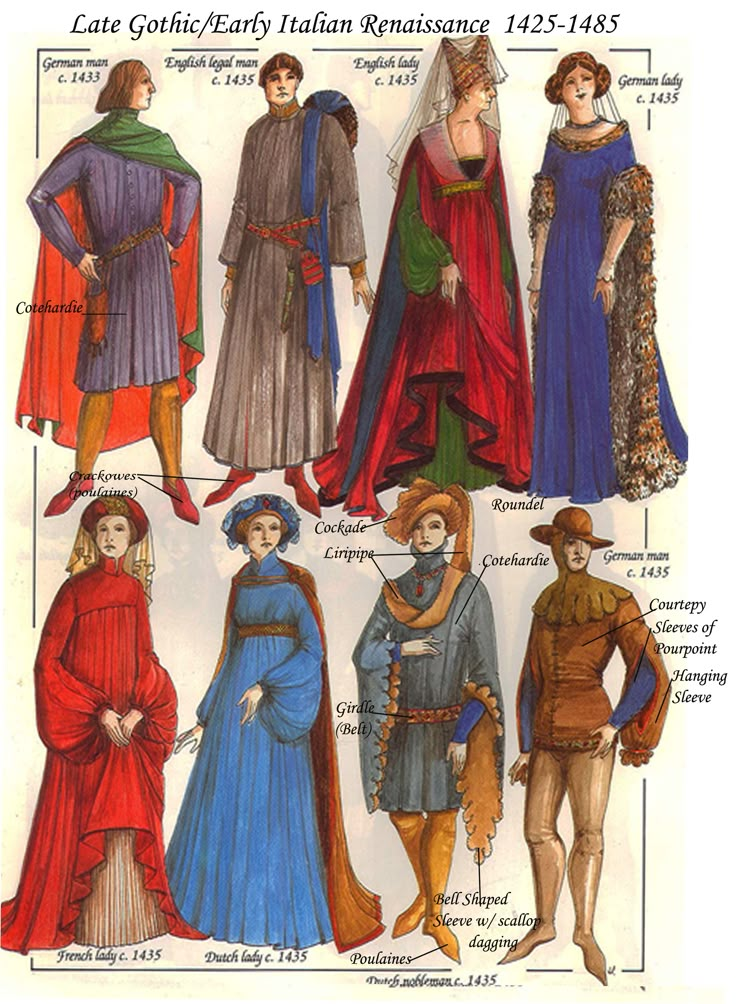
A respectable Italian woman's outfit was built in layers, and each layer had a name. Against the skin she wore the camicia, a linen chemise that absorbed perspiration and protected the expensive outer fabrics from oils and dirt. Over that came the gamurra, a fitted gown usually cut with a defined waist and a laced bodice, made in wool or silk depending on the household's budget. For colder weather or greater formality, a cipriana or cioppa went on top — an overgown, sometimes with open sides or hanging sleeves that revealed the gown beneath.


The giornea added a final dramatic layer in the fifteenth century, a sleeveless, unfitted overgarment that could be pleated at the shoulders and worn open at the sides. Sleeves were a fashion unto themselves and were frequently detachable, tied or pinned at the armhole so that a single gown could be restyled for different occasions. This modular approach made economic sense and stylistic sense at once, allowing a family to update an expensive dress without replacing the entire structure.
Men's Dress: The Doublet, Hose, and the Rise of the Leg
Men's fashion in medieval Italy changed more dramatically than women's, largely because of one innovation: the pairing of a short, fitted jacket with joined hose. The farsetto, the Italian version of the doublet, reached only to the hip or upper thigh, and the calze covered each leg individually, laced or pointed to the jacket so the two functioned as a unit. This combination made the leg itself a feature of display, and men began wearing shorter hemlines than their grandfathers would have considered decent.
Over the farsetto, a man might wear the cioppa, a long overgown reserved for formal or civic occasions, or a mantle fastened at the shoulder. In Venice, patrician men adopted the lucco, a deliberately plain, ankle-length gown in a sober color that signaled membership in the ruling class rather than personal wealth. It is a striking example of how Italian fashion could communicate restraint as powerfully as extravagance when political circumstance demanded it.
Ornament, Accessory, and the Language of Display
Accessories did the work that fabric alone could not, allowing wearers to adjust their social signal without commissioning an entirely new wardrobe. A plain wool gown paired with a gold-fitted belt, a string of pearls, and carefully dressed hair read very differently from the same gown worn unadorned. Goldsmiths in Florence, Siena, and Venice produced buttons, brooches, and chains of remarkable refinement, and the surviving inventories of wealthy households list these small objects in exhaustive detail.
Embroidery was another route to distinction. Professional embroiderers worked gold and silver thread onto collars, cuffs, and the edges of mantles, and women of means embroidered at home as a mark of virtue as well as skill. Fringe, braid, and applied trim could transform an older garment into something current, which mattered in a culture where clothing was expensive, endlessly repaired, and rarely discarded.
Headdresses, Hair, and the Veil
Headwear in medieval Italy carried strong signals about marital status and respectability. Unmarried girls generally wore their hair loose and uncovered, often with a simple garland, while married women covered their heads with a linen cloth, a veil, or a more elaborate structured piece. The trinzale, a close-fitting white linen cap that covered the hair and neck, formed the base of many arrangements, with the veil or outer covering pinned over it.
The most florid development was the balzo, a padded, rolled headdress worn high on the head and sometimes wound with pearls, ribbons, or a length of gauze. Hair itself was a project: women used lemon juice, saffron, and prolonged sun exposure to lighten their hair toward the golden blond celebrated in poetry, and the practice was common enough that travelers commented on it. Braids wrapped with colored ribbon remained popular throughout the period, particularly in the northern cities.
Shoes, Belts, and Bags
Feet got far more attention than the practical realities of medieval streets might suggest. Soft leather shoes with pointed toes were standard, and to protect them from mud and refuse, Italians wore pattens or zoccoli — wooden overshoes or platforms strapped beneath the shoe. In Venice, these platforms eventually developed into the famous chopines, elevated footwear that required a servant's arm to navigate and became an unmistakable mark of elite status.
Belts, meanwhile, were both functional and highly decorative, fitted with copper, silver, or gilt mounts and worn at the hip or waist. Small leather pouches hung from them, sometimes with a knife, a set of keys, or a rosary, and the contents of a pouch could say as much about a person as the cut of a gown. Gloves, fans, and embroidered purses completed the picture for those who could afford them, turning a body into a collection of carefully chosen statements.
The legacy of these garments lives on in every museum case and altarpiece that preserves them, and in the broader idea that dressing well is a form of communication rather than mere vanity. Italian tailors of the trecento and quattrocento invented solutions — modular sleeves, structured bodices, graded patterns — that later European fashion simply inherited and refined. If you want to see this world rather than read about it, spend an afternoon with the frescoes of the Palazzo Pubblico in Siena or a quattrocento portrait in the Uffizi, and look at the seams rather than the faces. The stitching has a great deal to tell you.
Related Articles

1912 Fashion: Edwardian Elegance, Trends, and Timeless Style
1912 was a year balanced on a knife's edge between two worlds. In April, the RMS Titanic slipped beneath the North Atlantic carrying a cargo of silks, laces...

Italian Design: Timeless Elegance, Iconic Style & Modern Inspiration
Italian design is far more than a look or a trend. It is a way of thinking about objects, spaces, and the people who use them, shaped by centuries of...

Lennon and Lace: Chic Boutique Fashion, Timeless Style & Must-Have Trends
When people hear the phrase "Lennon and lace," they often picture two contrasting worlds stitched together: the raw, rebellious spirit of rock and roll and the...

Polaroid Clothing: Retro Fashion That Snaps Back in Style
Polaroid clothing turns the unmistakable charm of instant photography into something you can wear. Think graphic tees stamped with the rainbow spectrum...

Fashion Winter 2017: Top Trends, Outfit Ideas & Style Guide
Fashion winter 2017 was a season of contrasts: plush velvet and utilitarian puffers, polished tailoring and rebellious streetwear, nostalgic textures and...

Denise Huxtable Fashion: Iconic 90s Style & Outfit Inspiration
Denise Huxtable fashion remains one of the most influential style legacies of 1980s and early 1990s television. As the free-spirited second daughter on The...