Hummingbird Symbolism in the Bible: Spiritual Meaning and Biblical Lessons
Few creatures stir the human heart quite like the hummingbird. It hovers midair, wings blurred into a shimmer, its throat flashing green or ruby as it drinks from a blossom. So it is no surprise that when people search for "hummingbird symbolism bible," they are usually asking one of two questions: does the Bible actually mention hummingbirds, and if it does not, what spiritual meaning can a Christian faithfully draw from them?
The honest answer is both disarming and liberating. The hummingbird never appears in Scripture by name, yet the themes it embodies — joy, provision, resurrection, wonder, and the nearness of God — run like a bright thread through the entire biblical narrative. Understanding how to connect a physical creature to scriptural truth without inventing verses is where the real insight lies.
Are Hummingbirds Mentioned in the Bible?
Scripture names a surprisingly wide range of birds: eagles, doves, sparrows, ravens, ostriches, storks, herons, hoopoes, owls, and quail. The hummingbird is not among them. The reason is not theological but geographical. Every one of the roughly 360 species in the family Trochilidae is native to the Americas, from Alaska to Tierra del Fuego. The biblical writers lived in the ancient Near East and the Mediterranean world, where hummingbirds simply do not exist in the wild.

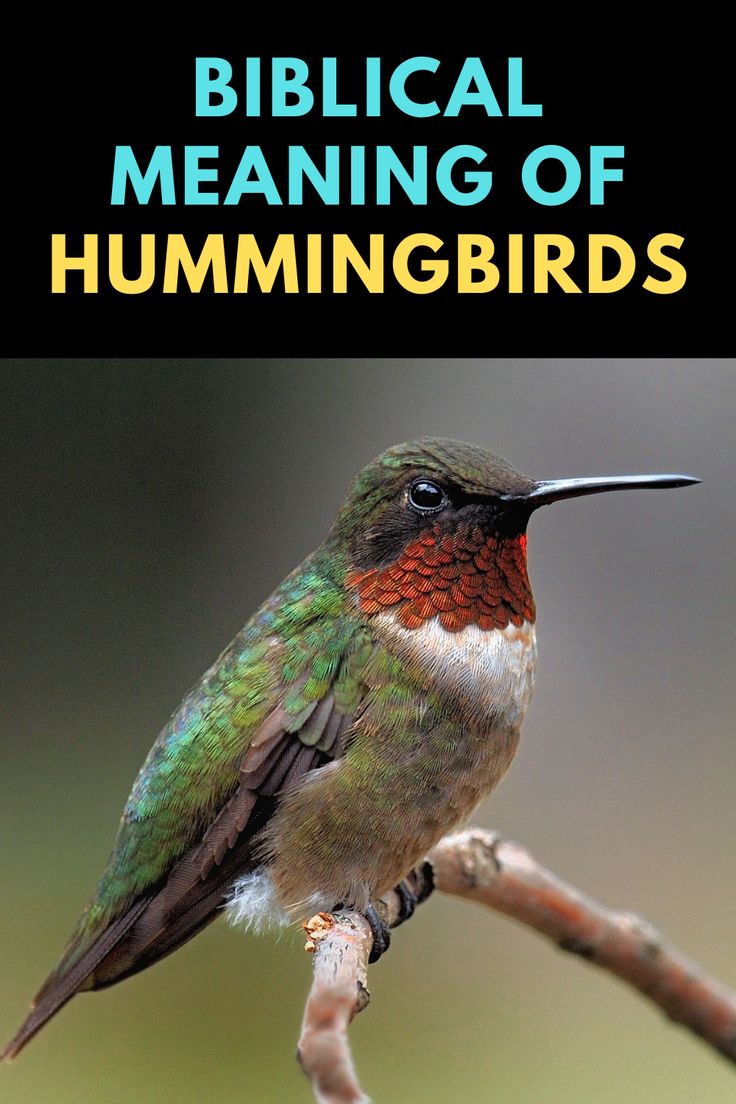

That absence carries real weight for interpretation. It means any viral post claiming "the Bible says the hummingbird is a messenger from heaven" is using devotional language rather than citation. It also means passages frequently attached to hummingbirds — Isaiah 40:31 with its eagles, Matthew 6:26 with its birds of the air — were written with other species in mind. Handled honestly, that fact makes the symbolism stronger, not weaker, because it rests on principle rather than proof-texting.
Why the Hummingbird Is Absent from Scripture
The biblical world was an agrarian and wilderness landscape, and its bird imagery grew out of daily observation. Sparrows were sold two for a copper coin. Ravens brought bread to Elijah in the ravine. A dove returned to Noah with an olive leaf. These images worked because every listener had seen the bird in question, and the Hebrew and Greek vocabulary of Scripture reflects that local knowledge.


Some readers point to the lists of clean and unclean birds in Leviticus 11 and Deuteronomy 14, wondering whether an obscure Hebrew term could mean hummingbird. Scholars generally identify those terms with birds of prey, waterfowl, and carrion eaters known in the region — herons, hoopoes, bats, and similar creatures. No credible lexical evidence supports a hummingbird reading. General categories such as the Hebrew tsippor, simply meaning "small bird," are as close as the text comes, and that is a category, not a species.
Reading Symbolism into Creation Without Adding to Scripture
There is a meaningful difference between eisegesis, which reads a preferred meaning into a text, and natural theology, which learns about God from the created order. Romans 1:20 says that God's invisible qualities are perceived in what has been made, and Psalm 19:1 declares that the heavens pour forth speech. A believer can therefore look at a hummingbird, feel awe, and worship the Creator without claiming the bird is a biblical symbol.
Practically, this means using the hummingbird as an illustration rather than a proof text. If a devotional says "the hummingbird reminds us that God sustains the smallest of creatures," that is a reflection drawn from Matthew 6, not a claim about hummingbirds in the canon. Keeping that distinction clear protects both the integrity of Scripture and the beauty of the observation.


Core Biblical Themes the Hummingbird Reflects
Even without a verse to its name, the hummingbird maps onto an extraordinary number of scriptural themes. It beats its wings 50 to 80 times per second, its heart can exceed 1,200 beats per minute during flight, and it enters a state of torpor at night to survive the cold. It hovers with precision no other bird can match, and its iridescent plumage is produced not by pigment but by microscopic structures that bend light.
Each of those biological facts suggests a spiritual parallel. The relentless energy points to diligence and joy. The hovering stillness points to attentiveness and prayer. The nighttime torpor, a daily descent into near-death followed by morning revival, is one of nature's most striking pictures of rest and renewal.
| Hummingbird Trait | Physical Reality | Biblical Theme |
|---|---|---|
| Hovering flight | Unique wing rotation and figure-eight motion | Abiding and attentiveness (John 15:4) |
| Rapid wingbeat | 50 to 80 beats per second | Diligence and wholehearted service (Colossians 3:23) |
| Iridescent feathers | Structural color, not pigment | Reflecting God's light (Matthew 5:16) |
| Nightly torpor | Metabolism drops to survive the cold | Rest and renewal (Psalm 4:8) |
| Constant feeding | Feeds every 10 to 15 minutes | Daily bread and trust (Matthew 6:11) |
Joy, Delight, and the Goodness of Creation
Psalm 104 celebrates a God who made creatures simply for the pleasure of making them, and the hummingbird fits that celebration perfectly. Its shimmering throat, its darting courtship displays, its habit of returning to the same favorite flower again and again — all of it feels like delight rather than mere survival. Proverbs 8 pictures wisdom rejoicing in the created world, and the hummingbird is a small, vivid echo of that joy.


Paul wrote, "Rejoice always," and Nehemiah reminded a grieving people that the joy of the Lord is their strength. A hummingbird in a summer garden is a living illustration of both. More than that, its iridescent feathers do not generate their own light; they refract the light that falls on them. Jesus told his followers to let their light shine before others, and the hummingbird offers a gentle picture of a creature that becomes radiant only by receiving.
Provision and Trust: Lessons from a Bird That Never Stops
Matthew 6 contains the most famous bird sermon in history. Jesus points to the birds of the air, notes that they do not sow or reap or store in barns, and concludes that the heavenly Father feeds them. Hummingbirds embody that passage with unusual intensity. Their metabolism is so demanding that they must feed every ten to fifteen minutes during the day, and they cannot survive a single night without entering torpor.
Yet they do not hoard. They do not build granaries. They wake, they drink, they rest, and they wake again. That rhythm mirrors the manna in the wilderness, which could only be gathered one day at a time, and the prayer Jesus taught his disciples: give us today our daily bread. For anyone prone to anxiety, the hummingbird is a small, feathered argument for trusting God with the present moment rather than the distant future.
How Hummingbird Symbolism Shows Up in Christian Life Today
Walk through any Christian gift shop and you will find hummingbird pendants, sympathy cards, garden stones, and memorial wind chimes. The image has become a quiet staple of Christian comfort culture, particularly in the American South and in Latin American communities where hummingbirds carry their own long-running folk associations with love and endurance.
At the same time, hummingbird symbolism sits close to New Age and metaphysical ideas about spirit guides, signs, and omens. Christians who want to appreciate the bird without drifting into superstition need a clear framework: creation can comfort and instruct, but it does not speak with the authority of Scripture, and it never mediates between the living and the dead.
Comfort, Visitation, and Remembrance
Many grieving families tell the same story. In the days after a loss, a hummingbird appears at the kitchen window, hovers for a moment, and disappears. The family reads it as a visitation, a small reassurance that the person they loved is safe and that God has not forgotten them. Interpreted as a tender reminder of God's nearness, that reading can be genuinely healing.
Scripture gives it a firm foundation. Psalm 34:18 says the Lord is close to the brokenhearted. Jesus promised comfort to those who mourn, and Paul describes God as the Father of compassion who comforts us in all our troubles. The key is to receive the moment as a gift rather than treat the bird as a channel. Thank God for the comfort, hold fast to the hope of resurrection in 1 Thessalonians 4:13, and let the hummingbird remain what it is: a creature that pointed your heart upward.
Stewardship, Wonder, and Worship
Hummingbirds are also a call to responsibility. Habitat loss, pesticide use, and shifting climate patterns have pushed several species toward decline. Genesis places humanity in the garden to work it and keep it, and Proverbs 12:10 observes that the righteous care for the needs of their animals. A backyard planted with native trumpet vine, bee balm, or salvia is a quiet act of obedience.
The practical steps are simple. Skip pesticides, keep nectar feeders clean with a simple sugar-and-water mix rather than dye, plant native flowers that bloom across the season, and let a corner of the yard stay wild. Wonder leads naturally to worship. Psalm 8 asks, "What is mankind that you are mindful of them?" — and a two-gram bird hovering at a flower answers that question with a beauty that feels almost excessive, as if God delighted in giving more than was strictly necessary.
The next time a hummingbird pauses at a blossom near you, let the moment do its work. Stand still, watch the blur of wings, and let the smallness of the creature and the extravagance of its design turn your attention toward the One who numbers the sparrows and clothes the lilies. If you want to go further, open Psalm 104 or Matthew 6 this week and read them with a hummingbird in mind — you may find that the oldest words in the book suddenly sound new.
Related Articles

Biblical Meaning of Hawk Sightings: 7 Spiritual Signs and Symbolism Explained
A hawk cutting across an open field has a way of stopping a person mid-step. The wings hold steady, the head stays fixed on something you cannot see, and for a...

Allium Flower Meaning: Symbolism, Spiritual Significance, and Hidden Messages
Allium flower meaning begins with a delightful contradiction: these bold, globe-shaped blooms belong to the same plant genus as onions, garlic, chives, and...

Ash Tree Meaning: Symbolism, Mythology, and Spiritual Significance Explained
Few trees carry as much symbolic weight as the ash, a slender hardwood whose name echoes through Norse creation myths, Celtic ritual, and the everyday tools of...

Lavender Color Meaning: Symbolism, Psychology, and Spiritual Significance
Lavender color meaning blends softness, clarity, and quiet strength. It is a pale purple with blue undertones, less intense than violet, more soothing than...

What Does the Lotus Flower Represent? Meaning, Symbolism, and Spiritual Significance
The lotus flower is one of the most enduring symbols in human history, emerging from murky ponds to bloom with an almost otherworldly grace. Its daily cycle of...

Green Color Meaning: Symbolism, Psychology, and Spiritual Secrets Explained
The color green sits at the intersection of nature, emotion, and culture. It is the hue of leaves after rain, moss on stone, and traffic lights that tell us to...