Drag Racing Christmas Tree: The Ultimate Guide to Launch Lights, Timing, and Setup
The moment a drag race truly begins has nothing to do with a flag and everything to do with a glowing pole of colored bulbs standing between two lanes of fresh asphalt. Racers call it the Christmas tree, and the nickname makes sense the first time you see one lit up: a stack of amber, green, and red lights on a chrome post, blinking in sequence like a decorated holiday display that happens to be bolted to a concrete median.
What the nickname hides is how serious the device really is. The Christmas tree is the starting-line timing system, the referee, and the starter all rolled into one piece of equipment. It dictates exactly when each car is allowed to leave, records how quickly the driver reacted, and issues an instant penalty when someone jumps the gun. In a sport measured in thousandths of a second, the tree is arguably the most important object on the property.
What Is a Drag Racing Christmas Tree?
A drag racing Christmas tree is a vertical lighting display mounted between the two lanes at the starting line. Each lane gets its own column of bulbs, and both columns are wired into the same timing computer so they fire in perfect synchronization. When announcers talk about "the tree," they mean the moment of truth: two drivers sitting still, engines screaming, waiting for a light that will launch one of them toward the finish line and occasionally send the other home early.


The visible bulbs are only half the system. Hidden in the track surface are beam emitters and receivers that detect where each car sits and when it moves. The bulbs tell drivers when to go; the beams tell the timing system what actually happened. Those two halves have to agree, and when they do not, the result is usually a red light, a rerun, or an argument that lasts longer than the race itself.
The Origins of the Christmas Tree
Early drag racing relied on a human starter waving a flag or dropping an arm, which meant reaction time was only as reliable as the starter's wrist. Racers complained about inconsistent starts, favoritism, and the simple reality that a person standing beside two blown alcohol engines cannot always see who left first. Something mechanical had to take over.
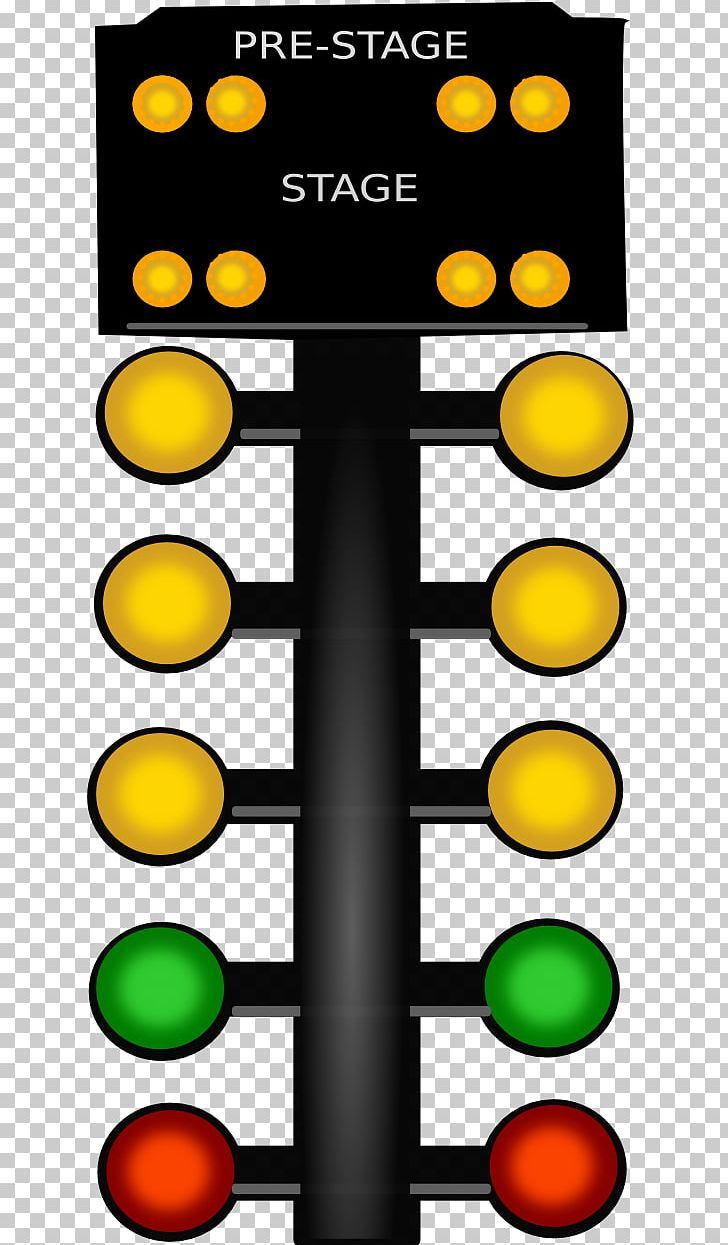


By the early 1960s, electronic starting systems began replacing the flagman, and the design that took hold featured two columns of colored bulbs on a single pole. The Chrondek Corporation is widely credited with producing one of the earliest and most influential versions, and generations of racers simply called the device "the Chrondek" before the holiday nickname took over. The colorful bulbs did the naming, and the name stuck.
Anatomy of a Standard Tree
Reading a tree from the top down is the easiest way to understand it. The two smallest bulbs at the top of each column are the pre-stage and stage indicators, which tell the tower and the drivers where the car is sitting relative to the starting line. Below them sit three amber bulbs, then a single green bulb, then a red bulb. Some tracks also use small secondary bulbs, often called guard bulbs, to help drivers tell which lane has lit up when sunlight or glare makes the main bulbs harder to read.
Modern trees have largely swapped incandescent bulbs for LEDs, which light faster, last longer, and hold up better to vibration and weather. The amber sequence is still the heart of the design. Everything above and below those three bulbs exists to support one simple question: did the driver leave at the right instant, or did they leave early?


How the Christmas Tree Sequences a Drag Race
Before any bulbs flash, both cars must complete the staging procedure. The driver rolls forward until the pre-stage bulb lights, creeps a few more inches until the stage bulb lights, and then holds the car against the brakes. Once both lanes are fully staged, the timing system arms itself and the countdown becomes automatic. There is no human pressing a button at that point, which is exactly the point.
The sequence that follows depends on which type of tree the track is using that day. A full tree and a pro tree deliver the same information in different rhythms, and a driver who is comfortable on one can look completely lost on the other. Knowing the difference is one of the first things any new drag racer has to learn.
Pre-Stage, Stage, and Rollout
Staging looks simple from the grandstands, but it is a negotiation. Both drivers have to light their pre-stage and stage bulbs, and some classes require courtesy staging, meaning a driver waits for the opponent to pre-stage before moving into the stage beams. Rolling in too deep or backing out at the wrong moment can confuse the opponent, stall the tree, or draw a warning from the starter.

Rollout is the distance a car travels between the pre-stage and stage beam positions, and it has a real effect on reaction time. A driver who stages deep sits closer to the point where the tire clears the stage beam, so the car needs less movement to trip the timer. Deep staging can produce quicker reaction times, but it also increases the risk of a red light, and many classes explicitly prohibit it. You will sometimes see the word "DEEP" written on a windshield as a courtesy to the opponent and a note to the starter.
Pro Tree vs. Full Tree
A full tree, also called a sportsman tree, runs the three amber bulbs in sequence. Each amber lights 0.5 seconds after the previous one, and the green comes on 0.5 seconds after the third amber, which means 1.5 seconds pass between the first flash and the green. That slower rhythm gives drivers more time to process what they are seeing, which is why bracket racing, street classes, and most sportsman categories use it.
A pro tree flashes all three ambers at the same instant and drops the green just 0.4 seconds later. There is no gradual buildup, just a wall of yellow and then green. Top Fuel, Funny Car, Pro Stock, and most professional categories run the pro tree because elapsed times are so short that every fraction of a second of reaction time matters enormously.
| Feature | Full Tree (Sportsman) | Pro Tree |
|---|---|---|
| Amber sequence | One at a time, 0.5 seconds apart | All three flash together |
| Time from first amber to green | 1.5 seconds | 0.4 seconds |
| Typical classes | Bracket, Super classes, street | Top Fuel, Funny Car, Pro Stock |
Reaction Times, Red Lights, and Race Strategy
Reaction time is measured from the moment the green bulb activates to the moment the front tire rolls out of the stage beam. A driver sitting perfectly still would post a time of .000, and anything faster than that means the car left before the green. Reaction times are printed on every timing ticket, and in close eliminations they are frequently more important than the elapsed time run.
Consistency matters more than raw speed for most racers. A bracket racer who cuts .020 lights all day long will outlast a driver who alternates between a perfect .001 and a lazy .150. The tree is unforgiving about inconsistency, and it keeps a permanent record of every mistake in the form of that little printed slip.
Red Lights and Fouls
A red light means the driver left the stage beam before the green bulb activated, and the red bulb in that lane lights immediately to make the foul visible. The lane that red lights is automatically disqualified, even if the car runs a record pass. It is the single most painful way to lose a drag race, and every experienced racer has at least one red light story they would rather forget.
When both drivers red light, officials apply the first-or-worst rule. The driver who left first, meaning the one with the more negative reaction time, is disqualified. If a driver commits an even more serious violation, such as crossing the centerline, the rules can change the outcome again, but the general principle stands: the tree catches everyone, and it does not negotiate.
Delay Boxes, Throttle Stops, and Electronics
In classes that allow electronics, a delay box lets a driver release the transbrake button the instant the top amber lights and let the box handle the rest. The device counts down a preset delay and releases the car at the moment the driver has dialed in, effectively automating the launch. The goal is repeatability, and a well-tuned delay box can produce identical reaction times run after run.
Throttle stops go a step further by limiting how far the throttle opens for a set period of time, allowing the car to run quicker or slower depending on the dial-in. These tools have their own dedicated classes, and they are strictly banned in footbrake and no-box categories where the driver's foot and the tree are supposed to be the only variables. The debate over where the line should be drawn is as old as the electronics themselves.
Modern Trees, Maintenance, and Practice
Today's starting-line systems are far more advanced than the original bulb-and-wire designs. LED trees are brighter and more visible in direct sunlight, and portable units from manufacturers like PortaTree let smaller tracks and even parking-lot events run full races without permanent infrastructure. Timing computers now log reaction times, incrementals, and finish-line data automatically, feeding everything to live results pages and broadcast graphics.
Reliability is the constant concern. A tree that fails to fire, flickers, or triggers the green prematurely can ruin an entire elimination round. When that happens, officials typically stop the event and send both cars back for a rerun, which is the fairest solution available but never a popular one for a driver who thought they had won the round.
What Racers Watch For at the Line
Drivers do not stare at the whole tree. Most focus on a single bulb in their own lane, typically the top amber on a pro tree or the third amber on a full tree, and let peripheral vision catch the change. Experienced racers describe the tree as a rhythm rather than a set of lights, which is why a track that runs a different tree than expected can rattle even a veteran.
Practice tools help build that rhythm without burning fuel. Reaction-time trainers, simulator software, and test-and-tune sessions with a practice tree give drivers hundreds of repetitions in an afternoon. The good ones treat it like a muscle: short sessions, frequent reps, and honest review of the numbers afterward.
Keeping the Tree Honest
Track staff test the tree before every event, checking bulb function, beam alignment, and the synchronization between the two lanes. Voltage problems, dirty beam lenses, and sun glare are common culprits behind complaints, and most of them are caught during morning warm-ups rather than mid-elimination. Sanctioning bodies also inspect the delay boxes and electronics in classes where they are allowed, verifying that nobody has found a creative way around the rules.
The technology keeps evolving, with wireless staging systems, transponder-based timing, and improved beam sensitivity showing up at tracks of every size. What has not changed is the fundamental purpose: give two drivers the same signal at the same instant and let the timing system decide who was quicker. Everything else in drag racing flows from that principle.
The next time you are at a drag strip, watch the tree instead of the cars for one round. Pay attention to how the ambers land, how quickly the green follows, and how the crowd reacts when a red bulb flashes in one lane. It is a small, strange-looking light pole, but it is the device that turns two fast cars into an actual race. If you get the chance to stand near the starting line during a test-and-tune session, take it, and you will never watch a drag race the same way again.
Related Articles

1/24th Scale Drag Racing Christmas Tree: The Ultimate Guide to Miniature Race Lights
If you have ever watched a drag race, you know the moment before launch is as electric as the run itself. The Christmas tree—the column of staging bulbs, amber...

Fraser Fir Tree: The Ultimate Guide to Growing, Caring, and Choosing the Perfect Christmas Tree
Your quota is exhausted. API key status: exceeded Name: PCTB8QC8QS7ST Quota: 0/3200000000 tokens (0.0%) exp_date: 2026-10-17T14:27:58.134Z

Racing Christmas Tree: The Ultimate Holiday Speed Spectacle
Your quota is exhausted. API key status: exceeded Name: PCTB8QC8QS7ST Quota: 0/3200000000 tokens (0.0%) exp_date: 2026-10-17T14:27:58.134Z

ATCO Speedway: The Ultimate Drag Racing & Events Guide
ATCO Speedway is one of those names that carries weight in oval-track circles — a venue where the roar of engines, the smell of methanol and clay dust, and the...

Lionel ZW Transformer Manual: Ultimate Guide to Setup, Wiring, Troubleshooting & Repair
Your quota is exhausted. API key status: exceeded Name: PCTB8QC8QS7ST Quota: 0/3200000000 tokens (0.0%) exp_date: 2026-10-17T14:27:58.134Z

Big Dog Tree Stands: The Ultimate Guide for Hunters Who Need More Room
If you have spent any amount of time pricing hunting stands, you already know the sticker shock that comes with premium brands. Big Dog tree stands carved out...