Monkeys vs Apes: The Key Differences Explained
If you have ever stood in front of a zoo enclosure and wondered whether the animal inside is a monkey or an ape, you are not alone. The difference between monkeys and apes is one of the most common questions in primatology, partly because the two groups look similar and share a deep evolutionary history. Yet the split is real, and it shows up in tails, skeletons, teeth, brains, behavior, and geography.
Understanding monkeys vs. apes matters beyond trivia. It clarifies how evolution works, why humans are classified as apes, and why conservation messages often separate the two. A monkey is not simply a small ape, and an ape is not just a tailless monkey. The distinction reflects millions of years of divergent adaptation across Africa, Asia, and the Americas.
The Core Biological Differences Between Monkeys and Apes
At the simplest level, apes belong to the superfamily Hominoidea, while monkeys are split between two major branches: New World monkeys, or Platyrrhini, and Old World monkeys, or Cercopithecoidea. This means “monkey” is not a single scientific clade in the same way “ape” is. Old World monkeys are more closely related to apes than they are to New World monkeys, so grouping every monkey together can be misleading.


Both monkeys and apes are primates, and both belong to the simian group known as Anthropoidea. They share forward-facing eyes, grasping hands, nails instead of claws, and complex social lives. The differences emerge in specific anatomical traits that become easy to spot once you know what to look for.
Tails and Posture: The Most Visible Clues
The most famous difference is the tail. Apes do not have tails, while most monkeys do. Apes have a coccyx, or tailbone, but no external tail. Monkeys use their tails for balance, communication, and in some New World species, grasping branches like a fifth limb. Spider monkeys, howler monkeys, and woolly monkeys have prehensile tails, a feature no ape possesses.


Posture adds another clue. Monkeys generally hold their bodies horizontally and move on all fours along branches or the ground. Apes have more upright, or orthograde, postures. Gibbons swing through trees with long arms, orangutans move carefully through the canopy, and chimpanzees and gorillas knuckle-walk on the ground. Humans are the only apes that habitually walk on two legs.
Teeth, Noses, and Skeletons: Hidden but Reliable Differences
Dental patterns separate the groups. Old World monkeys and apes typically have two premolars, while New World monkeys usually have three. Apes also have Y-shaped cusps on their lower molars, called Y-5 molars, and Old World monkeys have bilophodont molars with ridges. These details matter to paleontologists who identify fossil primates from teeth alone.
The nose is another giveaway. New World monkeys are platyrrhines, meaning flat-nosed, with widely spaced nostrils that open sideways. Old World monkeys and apes are catarrhines, with narrow noses and downward-facing nostrils. Apes also tend to have broader chests, more mobile shoulder joints, and a more flexible wrist, adaptations for climbing, hanging, and reaching overhead.


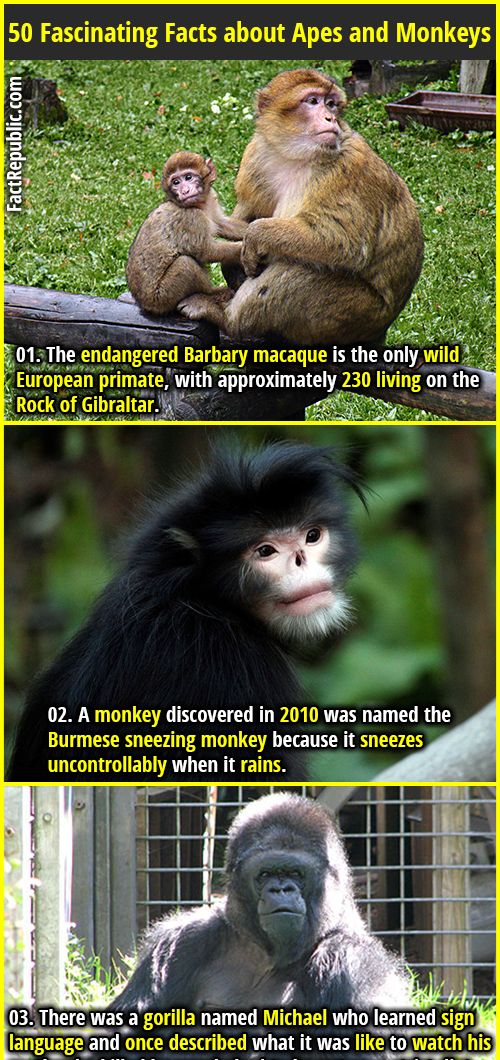


Monkeys vs. Apes in Behavior, Habitat, and Intelligence
Behavioral differences are not absolute, but they are striking. Apes generally have larger brains relative to body size, especially the great apes: orangutans, gorillas, chimpanzees, bonobos, and humans. This contributes to advanced problem-solving, tool use, and social learning. Monkeys are also intelligent, with capuchins and macaques showing impressive memory and tool skills, but ape cognition often reaches a different level of complexity.
Social systems vary widely in both groups. Many monkeys live in large troops with clear dominance hierarchies. Apes may live in pairs, small family groups, or flexible communities. Chimpanzees and bonobos use fission-fusion societies, splitting into smaller parties during the day and reuniting at night. Gibbons are known for pair bonds and duet songs, while orangutans are mostly solitary.
Where Monkeys and Apes Live
Geography is a practical way to narrow down an identification. Monkeys are native to Africa, Asia, Central America, and South America. Apes are native only to Africa and Southeast Asia. If you see a wild primate in the Amazon rainforest, it is a monkey, not an ape. If you see a chimpanzee in equatorial Africa or an orangutan in Borneo or Sumatra, you are looking at an ape.


The ranges overlap in Africa and Asia, where Old World monkeys and apes share forests and savannas. In those places, tails, body size, and shoulder shape help distinguish them. A baboon, for example, is a large Old World monkey with a tail and a dog-like muzzle. A gorilla is an ape with no tail, a massive body, and a broad chest.
Tool Use, Self-Awareness, and Culture
Apes are famous for flexible tool use. Chimpanzees fish for termites with twigs, crack nuts with stones, and use leaves as sponges. Orangutans make leaf umbrellas and use sticks to extract insects. Gorillas have been observed using sticks to gauge water depth. These behaviors are often passed down through generations, which scientists describe as cultural variation.
Self-awareness is another area where apes often stand out. Great apes can recognize themselves in mirrors, a capacity linked to complex social intelligence. Most monkeys do not pass the mirror test, though some may show rudimentary self-recognition. Monkeys still display culture, such as different grooming styles or alarm calls, but ape traditions tend to be more elaborate and varied.
The next time you watch a primate documentary or visit a sanctuary, look for the tail, the nose, the shoulders, and the social scene. Those clues will tell you whether you are watching a monkey or an ape, and they will also remind you that humans belong to the ape branch of the family tree. Support ethical sanctuaries and conservation groups that protect both monkeys and apes in their native habitats, because every species in this story is irreplaceable.
Related Articles

The Difference Between Astrology and Astronomy: Explained Simply
Ask someone to explain the difference between astrology and astronomy, and you may get a blank stare. Both words share a Greek root connected to stars, both...

Percent Difference vs Percent Change: Key Differences Explained Simply
Percent difference vs percent change is one of those distinctions that seems minor until a report, budget, or experiment depends on it. Both metrics compare...

Plaster vs Drywall: Key Differences You Need to Know
If you have ever renovated an older home or walked through a newly built one, you have likely felt the difference between plaster and drywall even if you did...

Rats vs Mice: The Real Difference Between Rats and Mice Explained
Telling the difference between rats and mice is not just a trivia exercise. Both are rodents, both can invade buildings, and both can carry pathogens, but they...

Puppy Food vs Dog Food: Key Differences Every Owner Should Know
Your quota is exhausted. API key status: exceeded Name: PCTB8QC8QS7ST Quota: 0/3200000000 tokens (0.0%) exp_date: 2026-10-17T14:27:58.134Z

Story vs Plot: The Key Difference Between Story and Plot Explained
Your quota is exhausted. API key status: exceeded Name: PCTB8QC8QS7ST Quota: 0/3200000000 tokens (0.0%) exp_date: 2026-10-17T14:27:58.134Z